
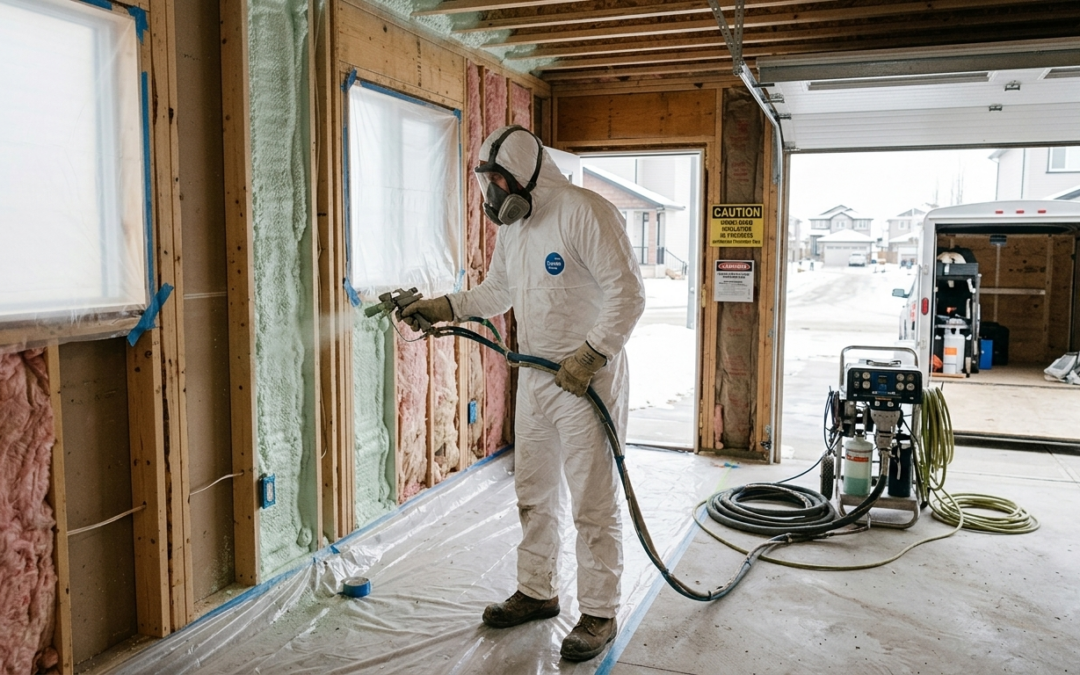
The quality of a spray foam installation depends on more than the product being used. Spray polyurethane foam is created at the job site as two liquid components travel through heated equipment, combine at the spray gun and react against the surface being insulated.
Equipment settings, surface conditions, application thickness and the installer’s technique can all affect the finished foam. This is why it is important to look beyond price when comparing spray foam contractors.
For residential, commercial, agricultural and industrial projects in Alberta, three areas deserve particular attention: preparation, application control and the detail provided in the project scope.
The Short Answer
A dependable spray foam contractor should inspect the work area, explain which product is being proposed and provide a clear plan for applying it. The contractor should also monitor job-site conditions, maintain control over the spray equipment and take appropriate steps to protect the building and its occupants.
1. Proper Planning Before the Installation
Spray foam should not be selected by R-value alone. The contractor first needs to understand the building, the location of the insulation and what the completed assembly needs to accomplish.
Insulating a basement rim joist is different from spraying the walls of a shop, sea can, attic or commercial building. Each project presents different conditions involving temperature, moisture, framing, ventilation and access.
Before preparing the final scope, the contractor should review:
- Where the spray foam will be installed
- The material and condition of the substrate
- Whether open-cell or closed-cell foam is appropriate
- The required insulation thickness
- Existing water entry or condensation concerns
- Electrical, mechanical and plumbing components
- Areas that require masking or protection
- How the insulation will connect around framing and penetrations
- Whether the finished foam will require a protective covering or coating
Spray foam should not be used to hide an active leak, wet sheathing, deteriorated framing or another unresolved building problem. If moisture is present, its source should be identified before the insulation is applied.
The Product Should Fit the Project
Different spray foam products have different properties and installation requirements. A contractor should be able to identify the exact product being proposed and explain why it is suitable for the application.
The product information should establish matters such as:
- Its intended uses
- Recommended application temperatures
- Minimum and maximum thickness per pass
- Required waiting time between passes
- Thermal performance
- Surface preparation requirements
- Fire-protection requirements
- Ventilation and re-entry instructions
Avoid relying on a general claim that one type of foam or one installation method is suitable for every building. The product, building assembly and intended result need to be considered together.
2. Control of Conditions During Application
Alberta weather can create challenging application conditions, especially in unheated buildings or during colder months. What matters is not simply the outdoor temperature, but the conditions where the foam meets the surface.
Before and during spraying, the contractor may need to monitor:
- Indoor or ambient temperature
- Substrate temperature
- Surface moisture
- Relative humidity
- Dew-point conditions
- Material temperature
- Equipment pressure
- The appearance and reaction of the developing foam
The acceptable range depends on the specific product. Cold-weather products may permit application at lower temperatures, while other materials require a warmer substrate. Heating the air without confirming the surface temperature may not be enough, particularly when spraying concrete, steel or exterior sheathing.
Surfaces should also be free from frost, standing water, oil, dust and other materials that could interfere with adhesion.
Application Thickness Is Product-Specific
Spray foam is often installed in more than one pass, but the allowable thickness of each pass is determined by the product manufacturer. It is not accurate to say that every closed-cell foam must always be installed in passes of two inches or less.
Applying more foam than permitted in a single pass can create excessive heat within the material. This can affect the foam’s structure, adhesion and overall performance. When multiple passes are needed, the contractor should follow the specified thickness and cooling time for that product.
The final depth should also be checked across the work area. A small number of thick sections should not be used to represent an installation that is otherwise too thin.
Equipment Condition Matters More Than Equipment Age
The age of a spray rig does not automatically determine the quality of the installation. Properly maintained equipment can continue to perform well, while newer equipment can still produce poor results if it is incorrectly set up or operated.
What matters is whether the proportioner, transfer pumps, heated hoses and spray gun can consistently deliver the components at the required ratio, temperature and pressure.
During application, the contractor should watch for changes in:
- Foam colour and texture
- Rise and reaction time
- Cell structure
- Adhesion to the substrate
- Component pressure
- Spray pattern
- Material yield
If the foam does not appear to be reacting correctly, spraying should stop so the cause can be investigated.
3. A Detailed Scope and Organized Work Site
A spray foam quote should describe what will be done rather than providing only a total price.
A useful written scope should identify:
- The areas included in the project
- The type and brand of spray foam
- The intended application thickness
- Preparation included in the price
- Surfaces and equipment that will be protected
- Items the property owner must move beforehand
- Whether trimming and cleanup are included
- Responsibility for any required protective covering
- Ventilation and re-entry instructions
- Warranty information and exclusions
This level of detail makes it easier to compare proposals. Two contractors may appear to be quoting the same project while allowing for different materials, thicknesses, preparation or cleanup.
Protection and Ventilation
Spray foam application requires a controlled work area. Nearby finishes, windows, doors, equipment and stored materials may need to be covered or removed to protect them from overspray.
Building occupants and other unprotected people should stay outside the designated work area during spraying. The contractor should explain how the area will be isolated, what ventilation will be used and when occupants or other workers may return.
The required waiting period should follow the instructions for the product being installed and the conditions of the project.
Inspecting the Finished Work
Before the foam is concealed, the completed application should be reviewed for:
- Consistent coverage
- Required depth
- Gaps or missed areas
- Proper adhesion
- Cracks, shrinkage or separation
- Unusual discolouration
- Overspray or damage to nearby surfaces
Irregular surfaces and framing can make perfectly uniform thickness difficult, but the overall installation should still meet the agreed project requirements.
Questions to Ask Before Choosing a Contractor
Before accepting a quote, consider asking:
- Which spray foam product will be used?
- Why is that product appropriate for this building?
- What thickness will be applied?
- Will the foam require multiple passes?
- How will temperature and surface moisture be checked?
- What preparation is included?
- How will nearby surfaces and equipment be protected?
- What ventilation and re-entry requirements apply?
- Does the foam require a protective covering or coating?
- What happens if a problem is found during or after installation?
A contractor should be able to answer these questions in clear, understandable terms.
Quality Begins Before Spraying Starts
A successful spray foam installation begins with an accurate assessment of the building and a clear understanding of what the insulation needs to accomplish. Product selection, surface preparation, equipment control and application conditions all contribute to the final result.
Taking time to review these details before choosing a contractor can help prevent misunderstandings and make it easier to compare the actual scope behind each quote.
If you are planning a spray foam insulation project in Spruce Grove, Edmonton or a surrounding Alberta community, contact Northern Spray Solutions to discuss the building, the proposed work area and your insulation goals.