
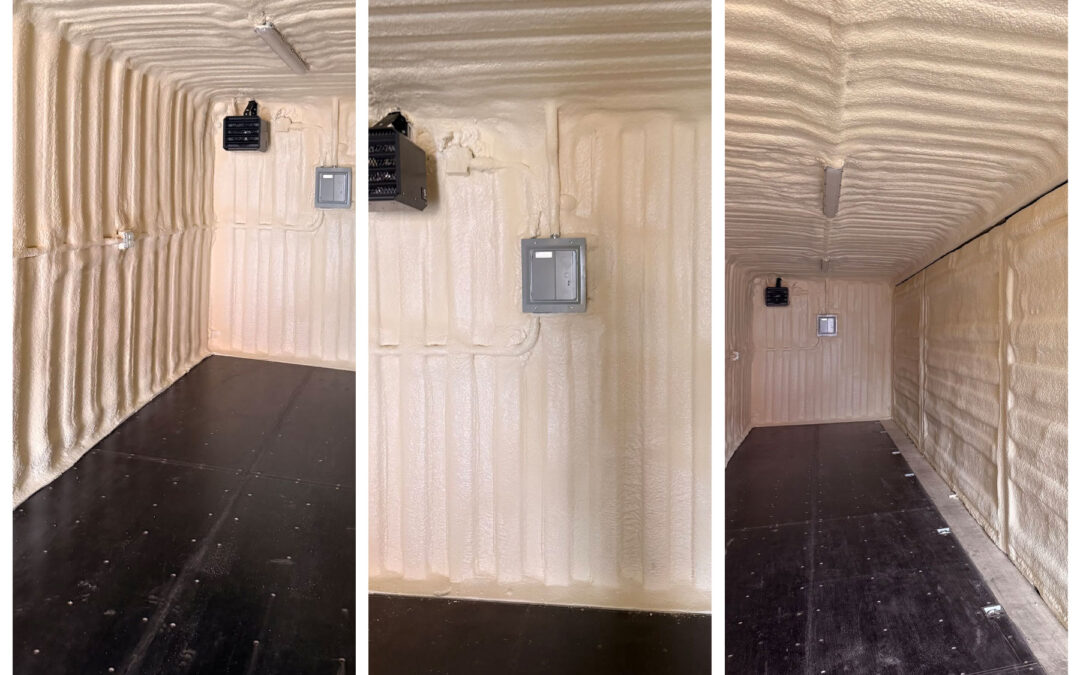
We recently completed a closed-cell spray foam insulation project inside a sea can in Leduc County, Alberta. With wet weather continuing outside, the enclosed container gave our crew a dry space to keep spraying while helping the owner prepare the unit for more practical year-round use.
Metal shipping containers are strong and versatile, but an uninsulated container can become extremely hot in summer and cold during an Alberta winter. Temperature changes can also cause condensation to form on the interior metal surfaces. Insulating the walls and ceiling helps create a more stable environment inside.
Why Closed-Cell Spray Foam Works Well in Sea Cans
The corrugated walls and ceiling of a shipping container can be challenging to insulate with rigid boards or batt insulation. Every ridge, corner and connection needs to be addressed, and gaps can reduce the effectiveness of the finished insulation.
Closed-cell spray foam is applied directly to the metal surface. As it expands, it follows the shape of the corrugated panels and forms a continuous layer across the walls and ceiling.
For a sea can, closed-cell spray foam can help with:
- Reducing heat loss during colder weather
- Limiting heat transfer during the summer
- Reducing air movement through small gaps and seams
- Controlling the conditions that can lead to condensation
- Adding rigidity to the interior surface
- Insulating irregular areas that are difficult to cover with conventional materials
Closed-cell foam is also more resistant to moisture than open-cell foam, making it well suited to many metal-building and shipping-container applications.
Insulating the Walls and Ceiling
For this Leduc County project, we applied spray foam across the container’s corrugated metal walls and ceiling. The foam was also carefully installed around the electrical panel, lighting, heater and other existing components.
Covering both the walls and ceiling is important. Insulating only one part of a metal container can leave large areas exposed to exterior temperatures. A continuous application provides more complete coverage and reduces the number of uninsulated gaps within the space.
The finished foam follows the shape of the metal panels while forming a consistent insulation layer throughout the interior. The black floor was left uncovered, allowing it to remain ready for the owner’s intended use or any additional finishing work.
Preparing a Shipping Container for Year-Round Use
Sea cans are used throughout Alberta for much more than transportation and temporary storage. Depending on how the container is prepared, it may be used as a workshop, equipment room, heated storage area or other functional space.
Before applying spray foam, we consider several parts of the project, including:
- How the container will be used
- Whether it will be heated
- The condition of the interior metal
- Electrical fixtures and other installed equipment
- Areas that need to remain accessible
- The amount of insulation required for the intended use
The metal surface must also be clean and dry before spraying. Even when the weather outside is wet, the interior substrate needs to be in suitable condition for the foam to properly adhere.
Sea Can Spray Foam Insulation in Leduc County
This project is a good example of how closed-cell spray foam can be used to insulate a corrugated metal space without leaving the numerous joints and cut edges that come with some other insulation methods.
Northern Spray Solutions provides spray foam insulation for sea cans, shops, garages, commercial buildings and other structures in Leduc County, Spruce Grove, Edmonton and surrounding Alberta communities.
If you are converting a shipping container or want to make an existing sea can more suitable for year-round use, contact us to discuss the project.