
One of the biggest questions Northern Spray Solutions gets is whether spray foam is actually worth the cost.
It is a fair question. Spray foam usually costs more upfront than some other insulation options. But the price conversation should not stop there. What matters is what you are getting for that cost and how the insulation performs over time.
For many homeowners, builders, and property owners, the value comes down to air sealing, moisture control, and long-term performance.
Why Spray Foam Costs More Upfront
Spray foam is often a bigger initial investment than batt insulation or other common materials.
That is usually the part people notice first. The quote is higher, so the natural question is whether the extra cost pays off in a meaningful way.
In many cases, the answer depends on the building, the area being insulated, and what problems you are trying to solve. If the goal is just to put something in the cavity, cheaper materials may look appealing. But if the goal is to reduce air leakage, help manage moisture, and get more consistent long-term performance, spray foam often becomes a different conversation.
You Are Not Just Paying for Insulation
With spray foam, you are not only paying for R-value.
You are also paying for how the material behaves once it is installed. Spray foam expands into gaps, adheres to the surface, and helps seal areas that are harder to deal with using cut-and-fit materials.
That can be especially useful around:
- wall cavities
- rim joists and joist ends
- window and door transitions
- vaulted ceilings
- irregular framing
- hard-to-reach areas
- renovation and retrofit work
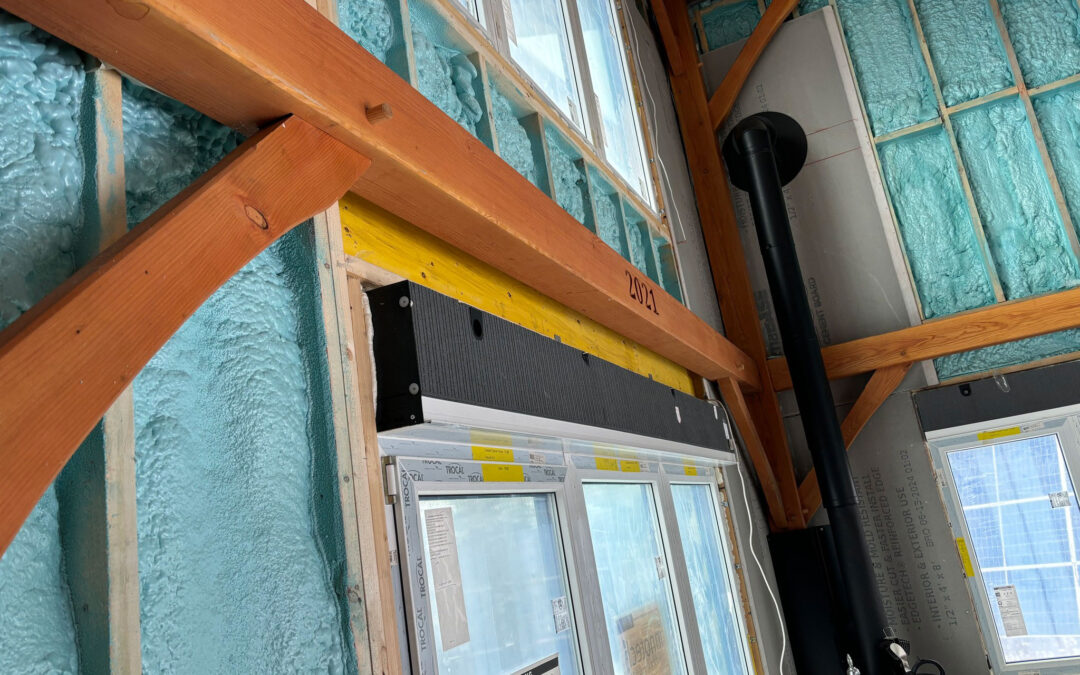
The photo from this project shows why that matters. The foam is installed directly into the wall cavities and around framing, helping create a more continuous insulated surface.
Air Leaks Are Part of the Real Cost
A lot of comfort and efficiency problems in a building come from air leakage, not just a lack of insulation.
If outside air is moving through gaps in the envelope, the building can feel drafty, harder to heat, and less consistent from one area to another. That is one reason spray foam is often seen as worth the investment. It helps insulate, but it also helps reduce the air movement that can make a building perform poorly.
That is a big difference between spray foam and materials that may insulate the cavity but do less to close off the gaps around it.
Moisture Matters Too
Spray foam is also often chosen because of how it helps manage moisture in the building envelope.
Moisture problems can start when warm air moves into cooler spaces, when gaps let outside conditions affect the wall assembly, or when materials are installed without enough attention to air sealing.
That does not mean spray foam is a cure-all. Good design, proper installation, and the right assembly still matter. But in many projects, spray foam helps create a tighter, more controlled building envelope, which is one reason people see long-term value in it.
It Does Not Settle or Shift Like Some Materials
This is one of the more practical reasons many people choose spray foam.
Some insulation materials can settle, shift, sag, or leave gaps over time. When that happens, performance can drop, especially in vertical cavities or areas with awkward framing.
Spray foam stays in place after installation. That stability is part of its long-term value. If the insulation continues to perform the way it was installed, the building has a better chance of staying comfortable and efficient over time.
That does not make spray foam the right choice for every project, but it is a real reason why many owners see it as worth the higher upfront cost.
When Spray Foam Often Makes Sense
Spray foam is often worth stronger consideration when:
- the building has noticeable air leakage
- comfort is inconsistent from room to room
- moisture control is a concern
- the framing is irregular or difficult to insulate well with batt
- the project is new construction with open walls
- the space includes joist ends, vaulted sections, or transition areas
- the owner wants a more durable long-term insulation approach
In these situations, the value is not only in the material itself. It is in the performance of the full assembly.
Is Spray Foam Worth It?
For many projects, yes, it can be.
The upfront cost is higher, but the value often comes from better air sealing, better control of problem areas, and insulation that stays in place and keeps performing over time.
That said, the right answer depends on the project. Some buildings benefit more than others. The best way to judge it is to look at the actual space, the construction details, and what you want the insulation to do.
If you are comparing insulation options, it helps to look beyond the initial price and ask how the material is likely to perform five or ten years from now.
Spray Foam Insulation in Edmonton and Area
Northern Spray Solutions provides spray foam insulation for residential, commercial, agricultural, and specialty projects in Edmonton, Spruce Grove, and surrounding areas.
If you are trying to decide whether spray foam is the right investment for your home, shop, garage, or new build, the next step is to review the space and talk through the options based on the actual job.
Want to Know if Spray Foam Makes Sense for Your Project?
Northern Spray Solutions can review your project and help you decide whether spray foam is worth it for the space you are insulating.